
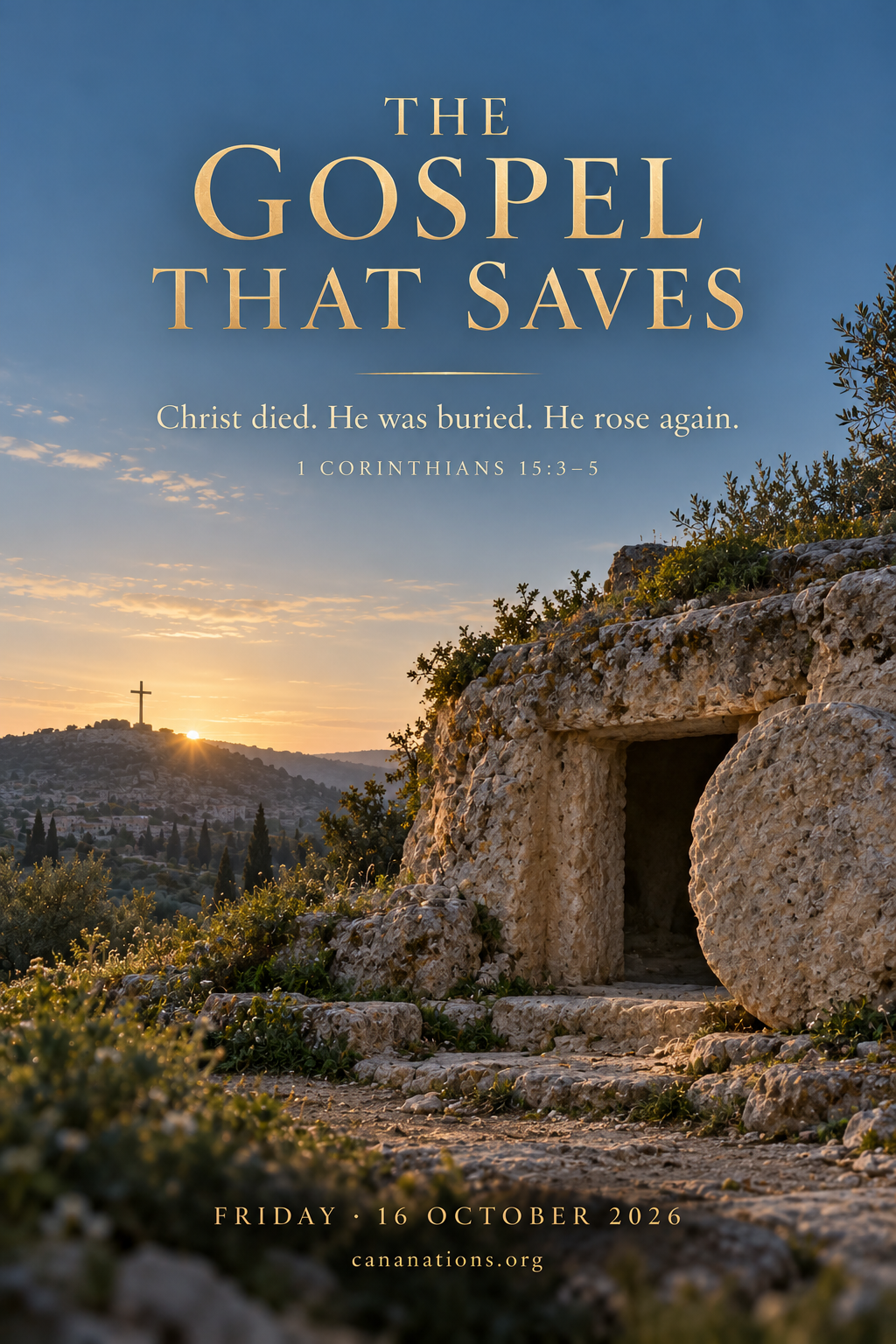
CANA DAILY · October 16, 2026
The Gospel That Saves.
“For I delivered unto you first of all that which I also received, how that Christ died for our sins according to the scriptures; And that he was buried, and that he rose again the third day according to the scriptures: And that he was seen of Cephas, then of the twelve.”1 Corinthians 15:3–5
The Gospel is not a religious slogan or a collection of human ideas. It is the good news of what God has accomplished through Jesus Christ. Paul says that he received this message and delivered it faithfully to the Church. The apostolic calling does not invent another foundation; it guards, proclaims, and builds upon the Gospel once entrusted to God’s people.
Paul begins by saying that this message is “of first importance” (1 Corinthians 15:3). Every ministry, gift, prophecy, church expression, and work of mission must remain under the authority of Christ’s death and resurrection. The Church is not sent to make human personalities great. We are sent to make Christ known.
CHRIST DIED FOR OUR SINS
The cross tells the truth about both God’s holiness and His mercy. Sin is not a small weakness that can be healed by better habits alone; it brings real guilt and separation from God. Yet God acted in love. Jesus, the sinless Son, gave Himself for our sins, bearing what we could not remove and opening the way for reconciliation with the Father (Isaiah 53:5–6; Romans 5:8).
The words “for our sins” keep the Gospel from becoming a message about self-improvement. We do not save ourselves by effort, ministry activity, or spiritual achievement. We turn from sin and trust the One who gave Himself for us. At the cross, grace does not call evil good; grace reveals the cost of sin and the depth of God’s saving love.
HE WAS BURIED
Paul does not pass quickly over the burial. Jesus truly entered death. He was not pretending to die, and the resurrection was not a metaphor for renewed hope. The burial confirms the reality of His death and the completeness of His humiliation. The Son of God went all the way into the place of human defeat, and no depth of our condition lies beyond the reach of His redeeming work.
The burial also teaches us to trust God when the promise seems hidden. The tomb looked final, but God was still working. A silent season is not proof that the Lord has abandoned His purpose. Our hope rests in the God who raises the dead.
HE ROSE AGAIN ON THE THIRD DAY
Jesus was raised bodily, in victory, according to the Scriptures. The resurrection is God’s declaration that Jesus is the Son, that His sacrifice is accepted, and that death does not have the final word. Paul later calls Christ “the firstfruits” of those who have fallen asleep (1 Corinthians 15:20). His resurrection is not an isolated miracle; it is the beginning and guarantee of the coming resurrection of all who belong to Him.
Because Christ lives, Christian faith is not optimism in difficult circumstances. It is confidence in the risen Lord. We grieve, but not as those without hope. We serve, endure, and proclaim because the living Christ is reigning and will complete what He has promised.
HE WAS SEEN
Paul names Cephas and the Twelve as witnesses. The resurrection was proclaimed as an event witnessed by people, not as a private feeling or spiritual symbol. The apostles were sent to testify to what God had done. Their message still calls the Church to bear faithful witness: Jesus Christ died, was buried, and rose again.
This is the apostolic pattern for ministry. We preach Christ from the Scriptures, depend on the Holy Spirit, call people to repentance and faith, and form disciples who obey Jesus. Prophetic ministry must point to the testimony of Jesus; spiritual power must serve His mission; and every expression of the Church must remain anchored in the Gospel.
RECEIVE, STAND, AND HOLD FAST
Paul reminds the Corinthians that they received this Gospel, stand in it, and are being saved as they hold fast to the word preached to them (1 Corinthians 15:1–2). We are saved by grace through faith, not by our works (Ephesians 2:8–9). Holding fast does not purchase salvation; it is the persevering response of a life that has truly heard and trusted Christ.
The Gospel is the beginning of the Christian life and its continuing center. It establishes our identity, corrects our message, strengthens us in suffering, and sends us to the nations. We do not move beyond Christ crucified and risen; we grow deeper into the riches of who He is and what He has done.
PERSONAL REFLECTION
Have I trusted in Christ’s finished work, or am I trying to earn God’s acceptance? Does the message I share keep Jesus at the center? Where is the risen Lord calling me to hold fast, obey, or bear witness today?
C.A.N.A. RESPONSE
Come Before God — Give thanks for Jesus Christ, who gave Himself for our sins.
Acknowledge His Truth — Confess that the crucified Jesus is risen and Lord.
Notice His Work — Name the places where His death and resurrection are giving you hope, courage, and new life.
Act in Obedience — Hold fast to the Gospel and make Christ known through your words and conduct.
Prayer
Father, thank You for the Gospel entrusted to the Church: Jesus Christ died for our sins, was buried, and rose again according to the Scriptures. Give me faith to stand in this truth and grace to hold fast. Form the life of the risen Christ in me, keep my message centered on Him, and send me as a faithful witness to others. In Jesus’ name, Amen.
Scriptural Reading: 1 Corinthians 15:1–11
Supporting Scriptures: Isaiah 53:4–6 · Romans 4:24–25 · Romans 10:9–13 · 1 Corinthians 15:20–22